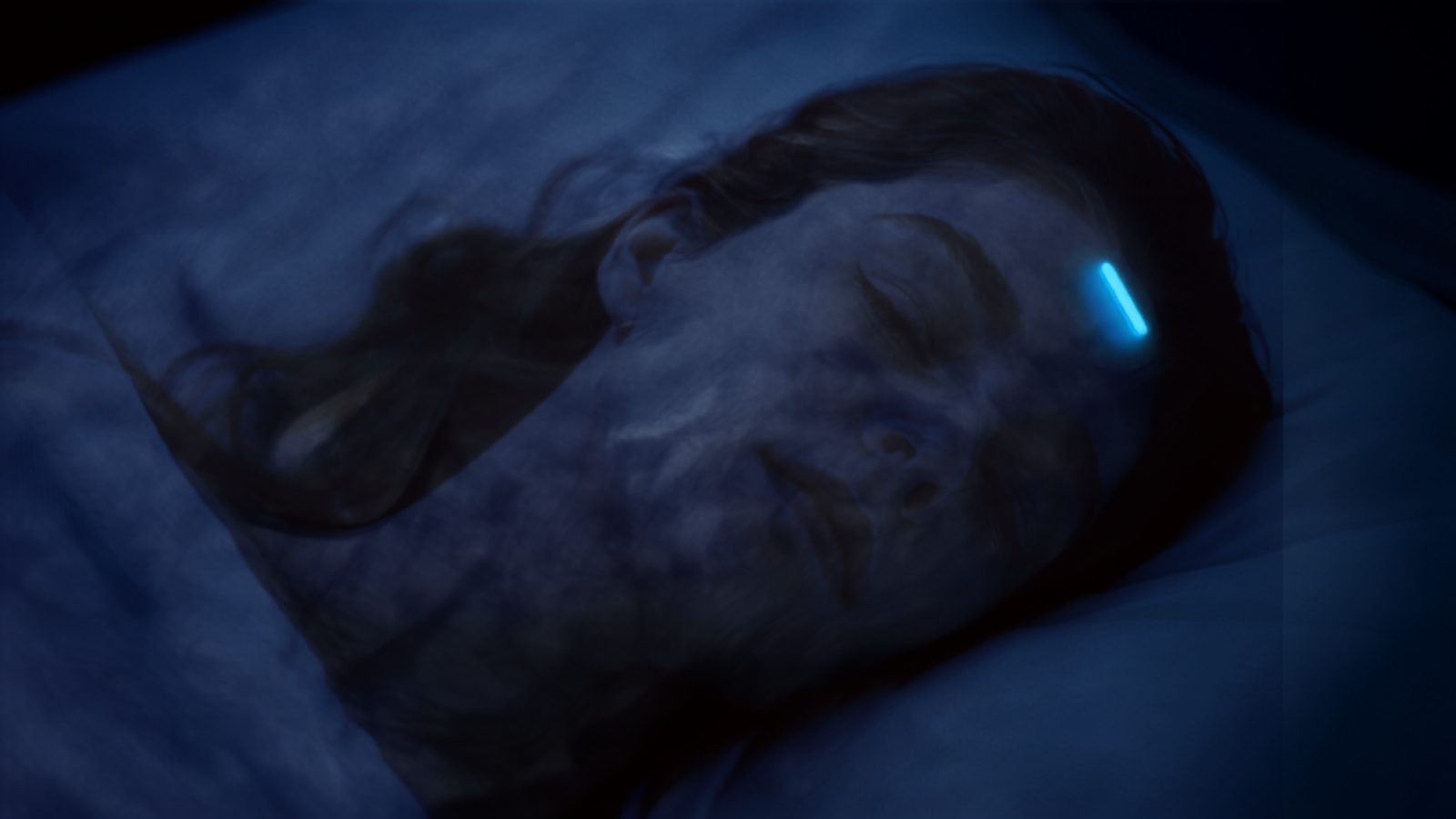
Most sleep tech on the market today works from the outside in — a cooler mattress, a weighted blanket, a wind-down app. A team at the University of Texas at Austin just published research on something that works the opposite way: a skin patch that reaches directly into the brain circuitry behind REM sleep, using nothing but gentle ultrasound. No surgery, no sedatives, no implant. The findings, published in Nature Communications, are early, but they're a genuinely different approach to a problem millions of people have never had a real fix for.
What the Patch Actually Does
The device, called NEUSLeeP, sits on the skin and combines two things at once: focused ultrasound waves that stimulate deep brain regions involved in REM sleep, and electrodes that monitor brain activity in real time. That combination is the notable part. Deep brain regions have historically only been reachable with implanted electrodes or invasive procedures, because ultrasound and electrical signals don't travel cleanly through skin and skull without careful calibration. The UT Austin team, led by biomedical engineering researcher Kai Wing "Kevin" Tang under the supervision of professor Huiliang "Evan" Wang, found a way to do it noninvasively, while simultaneously reading out what the brain was doing in response. "This is the first time we've been able to noninvasively target deep brain regions involved in REM sleep, while simultaneously monitoring brain activity," Tang said of the work.
In real-world testing on 28 participants — a mix of healthy sleepers and people with existing sleep issues — the patch produced measurable changes in a single night's sleep architecture. On average, wearers reached REM sleep 43 minutes faster than they otherwise would have, and once there, stayed in it for roughly 16 additional minutes. Healthy participants also showed improved heart rate variability, a marker generally associated with better stress resilience, and brain scans picked up changes in circuits tied to emotional processing. Researchers reported minimal side effects, with participants describing the patch as comfortable to wear overnight.
Why REM Sleep Is Worth Engineering For
REM is the sleep stage most associated with dreaming, but its job is bigger than that. Gregory Fonzo of UT's Dell Medical School, who worked on the study, put it plainly: "REM sleep is not just about dreaming — it's about emotional reset and stress adaptation." During REM, the brain processes emotionally charged experiences from the day and appears to strip some of their intensity, which is part of why chronic REM disruption keeps showing up in research on mood disorders, PTSD, and poor stress regulation. People don't usually complain about "not enough REM" the way they complain about feeling tired — but REM is disproportionately the stage that gets cut short by alcohol, certain medications, sleep apnea, and fragmented sleep in general, which means a lot of people are running a chronic REM deficit without realizing it's the specific piece that's missing.
That's what makes a tool that can directly extend and accelerate REM sleep interesting beyond the novelty factor. Most existing interventions for sleep quality — better sleep hygiene, cutting caffeine, a consistent schedule — work indirectly, by removing obstacles to good sleep. This is closer to directly dialing in the specific stage that does the emotional heavy lifting.
How Far This Is From Your Nightstand
It's worth being clear-eyed about where this actually sits: 28 participants is a small early-stage trial, not a validated consumer product. The team, which also includes sleep disorders specialist Vincent Mysliwiec of UT Health San Antonio, has filed a patent application and is working with UT's commercialization office, and larger trials are planned specifically targeting PTSD, depression, and chronic insomnia — populations where REM disruption is especially well documented. None of that means a version of this will be sitting on drugstore shelves anytime soon. Realistically, tools like this tend to take years to move from a promising first trial to something a doctor can prescribe, let alone something available over the counter.
In the meantime, the things that reliably protect the REM sleep you're already capable of getting haven't changed: a consistent wake time, cutting off alcohol several hours before bed (it's especially harsh on REM), and treating diagnosed sleep apnea, which chops REM sleep up disproportionately compared to other stages. If your nights already feel fragmented and you're not sure why, our guide to what REM sleep does and why it matters breaks down the mechanics in more depth, and our free Sleep Score Tool can help flag which specific habits might be cutting your own REM time short right now, while the research catches up.
- UT Austin researchers published a study in Nature Communications on NEUSLeeP, a noninvasive skin patch that uses ultrasound and electrodes to target brain regions involved in REM sleep.
- In a 28-person trial, the patch cut time to REM onset by 43 minutes on average and extended REM duration by about 16 minutes, with improved heart rate variability in healthy participants.
- REM sleep plays a key role in emotional processing and stress regulation, not just dreaming — making it a meaningful target for future PTSD, depression, and insomnia treatment.
- The device is still in early research, with a patent filed and larger trials planned; it is not yet an available consumer product.
It's a small trial and a long road to market, but the underlying idea — reaching a specific, measurable sleep stage directly instead of just clearing obstacles around it — is a meaningfully different direction for sleep science, and one worth watching as the larger trials get underway.
Source: UT Austin News — "Get Better Sleep With Ultrasound Patch That Boosts REM Rest," August 7, 2026, https://news.utexas.edu/2026/07/07/get-better-sleep-with-ultrasound-patch-that-boosts-rem-rest/
Medical disclaimer: This article is for informational purposes only and does not constitute medical advice. This device is investigational and not currently available or approved for consumer use. If you have concerns about sleep quality or a sleep disorder, please consult a qualified healthcare provider or sleep specialist.
About Better Night Sleep: Better Night Sleep is an independent sleep-education and product-research resource. Our articles are written and edited by the Better Night Sleep editorial team using reputable public sources and established sleep-health recommendations. Learn more about us.